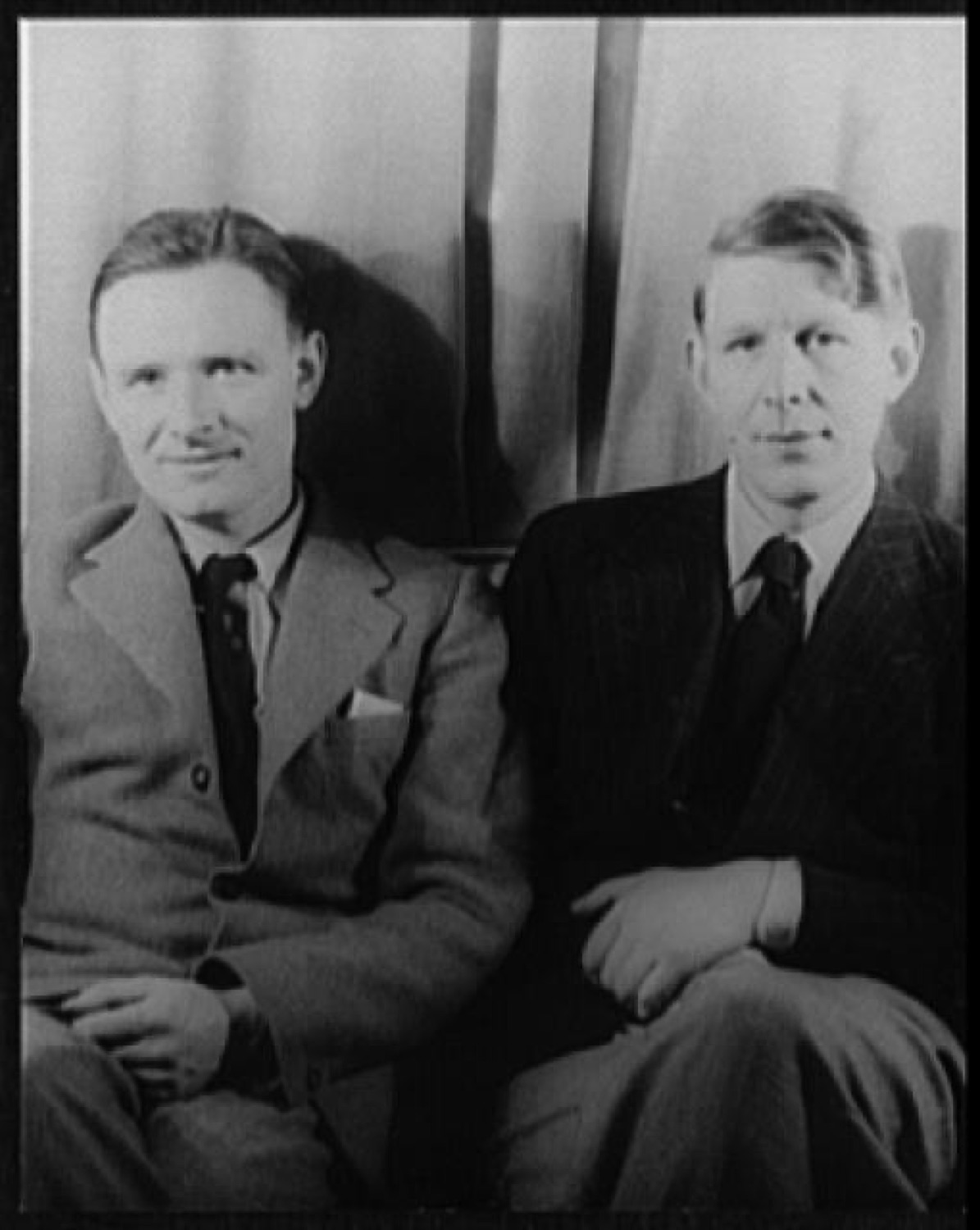
Christopher Isherwood (1904–1986) was one of the most important English writers of his generation. His novels Mr Norris Changes Trains and Goodbye to Berlin inspired the play I Am a Camera and the musical Cabaret, and he also wrote memoirs, biography and books on Hindu philosophy.
As a young man Isherwood embraced his homosexuality, a choice that took him to Berlin, capital of the Weimar Republic, a city famous for its sexual freedom and the feverish nightlife of a democracy on the brink of Nazism. Many of his best books came out of those years.
From Berlin to California
In January 1939 Isherwood sailed to the United States with his friend W.H. Auden. He settled in Southern California, wrote for the film studios and befriended younger writers such as Truman Capote, Tennessee Williams and Gore Vidal. Some critics have wondered whether Capote's Holly Golightly owes something to Isherwood's Sally Bowles, the reckless singer at the heart of Goodbye to Berlin.
Isherwood became a devoted follower of the Vedanta teacher Swami Prabhavananda, and wrote about their warm and funny relationship in My Guru and His Disciple (1980). He spent his last three decades with his partner, the artist Don Bachardy; David Hockney painted the couple in 1968. Isherwood died in Santa Monica in 1986, aged 81.
Why he matters
Isherwood had a lasting influence on late twentieth-century literature and on the gay rights movement. His male characters were nothing like the strong silent heroes of mid-century American fiction. They were sensitive, self-aware and often sexually ambiguous, and they opened the door to a different idea of masculinity. In an interview with The Paris Review he observed that anyone in the entertainment business compromises to some extent, Shakespeare included.
Where to start
- The Berlin Stories (Mr Norris Changes Trains, 1935, and Goodbye to Berlin, 1939). Berlin around 1931: cafés, cabarets, rented rooms and street fights as Hitler moves toward power. Mr Norris is a charming swindler who lives on borrowed money, nerve and luck, always one bad bet away from ruin, and Sally Bowles is unforgettable.
- Prater Violet (1945). A short, sharp comic novel about making a sentimental musical film in London while the real Vienna falls under Hitler's shadow, centred on a brilliant, imperious Austrian director.
- A Single Man (1964). One day in the life of George, an English professor in Los Angeles grieving the sudden death of his partner. Frank and humane for its time, funny and sad by turns. Tom Ford filmed it in 2009 with Colin Firth and Julianne Moore.
- Christopher and His Kind (1976). Isherwood's candid memoir of 1929 to 1939, setting the real people of his Berlin years beside the fictional versions, with Auden, Stephen Spender and E.M. Forster among the cast.
On screen
Bob Fosse's film of Cabaret (1972), with Liza Minnelli, Joel Grey and Michael York, made Sally Bowles a screen icon and won eight Academy Awards. It remains the best-known version of Isherwood's Berlin, though fans of the books will notice how much the darker, quieter originals differ.